- Failory
- Posts
- Refusing the Trend

Hey - It’s Nico.
Welcome to another Failory edition. This issue takes 5 minutes to read.
If you only have one, here are the 3 most important things:
Spoony, a social network for neurodivergent people, shut down — learn why below
Google adds AI Skills to Chrome
Meta just launched Muse Spark, its new family of AI models — learn why it matters below
A huge thanks to today’s sponsor, Lucid Engine. Measure and boost your product’s visibility in AI search so it gets recommended when buyers are ready to decide.

Capture high-intent traffic from AI search AD
ChatGPT is already recommending products in your category.
Your ideal customer might be asking for a tool like yours right now.
If you’re not mentioned in those answers, you don’t even make the shortlist.
AI search is becoming the final comparison layer before a buyer clicks anything. You need to know where you stand.
Lucid Engine helps maker teams:
Track how they rank across ChatGPT, Perplexity, and Google AI Overviews
See which competitors are mentioned instead
Identify the exact prompts driving recommendations
Get a clear, prioritized roadmap to improve visibility
No hype. No guesswork. Just structured data and actionable steps.
This Week In Startups
🔗 Resources
State of AI Agents in 2026
Surviving AI price wars without destroying your business
How to use AI without losing your mind
📰 News
Google adds AI Skills to Chrome
Sam Altman’s house was targeted in a molotov attack
Anthropic essentially bans OpenClaw from Claude
ChatGPT finally offers $100/month Pro plan
💸 Fundraising
Glydways raises $170m to support global expansion plans
Biometric analysis startup GameRun raises $4M
AI fintech startup Round raises $6 million
Slate Auto raises $650M to fund its affordable EV truck
Fail(St)ory

A Human Social Network
Last week, Spoony shut down.
It was built for people mainstream social apps usually overlook, and it seemed to be gaining real traction. Then it ran into a brutal startup problem: the clearest paths to survival risked turning it into a different company.
What Was Spoony:
Spoony was a social app built for neurodivergent, chronically ill, and disabled people. It was meant to be a place where people who are often isolated could actually meet, talk, and feel less alone.
The idea came from the founder’s own experience. Nicholas Carlton has said chronic illness pushed him out of a job he loved and made his world much smaller. He ended up leaning on other people with similar experiences for support. That became the starting point for the company.

You can usually tell when a founder is solving a problem they actually understand. The product tends to have more signal and less fluff. Spoony felt like that. It was not trying to be everything to everyone. It picked a specific group and built around needs mainstream social apps mostly ignore.
Spoony was incorporated in December 2023, and by August 2024 it had already built a waitlist of 30,000 people. Early signs looked strong. The company said beta users were opening the app 3-4 times a day, and reported a 25% reduction in loneliness.
The public launch came in October 2024. By then, Spoony had positioned itself somewhere between a social network, a peer-support system, and a health-adjacent community product. That in-between space was the opportunity. It was also the trap waiting later.
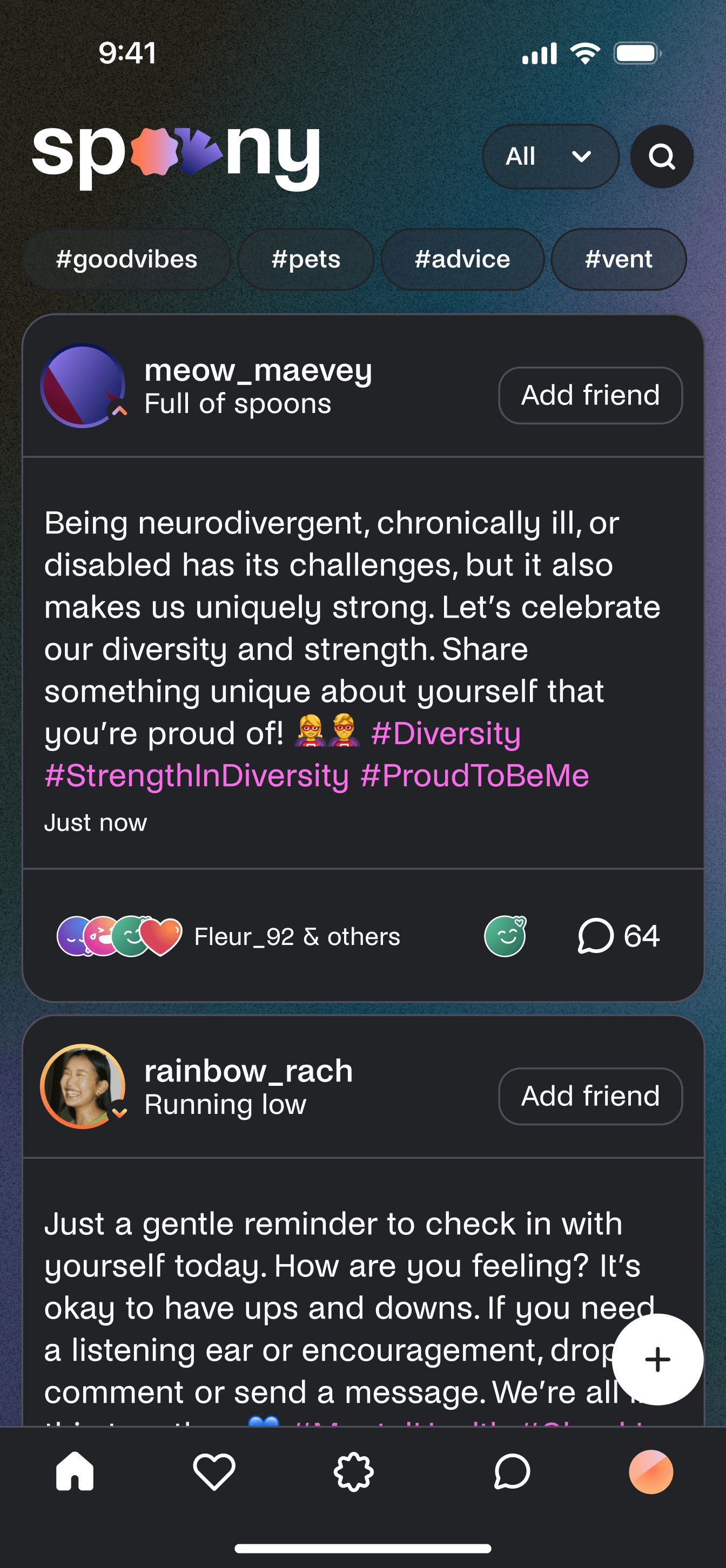
Investors bought the early story. Spoony raised A$1 million in pre-seed funding, with backing from Antler and others. The bull case was clear: strong founder-product fit, a big underserved community, early engagement, and a product that felt more meaningful than another disposable social feed.
By the time the shutdown was announced, Spoony had reached more than 65,000 users. Carlton also claimed its retention and engagement were “best-in-class for consumer social.” The full KPI set was never made public, so that is still founder framing. Even so, the broad picture is hard to miss: people wanted the product.
The real problem was that liking a product and financing a company are two different things. Spoony seems to have built real community value without finding a business model that fit either the mission or the market. That gap was manageable while capital was loose. It became fatal once it wasn’t.
The Numbers:
📅 December 2023 - incorporated
🚀 February 6, 2024 - public waitlist launched
👥 30,000 - waitlist signups by August 2024
🔁 3-4 times a day - reported beta usage
💛 25% - company-reported reduction in loneliness
📲 October 2024 - public launch
💸 A$1 million - pre-seed funding raised
📈 65,000+ - users by April 2026
⚠️ April 8, 2026 - shutdown announced
Reasons for Failure:
The next round fell through: Spoony planned to raise again in October 2025, and that round fell apart. Once that happened, every other weakness got exposed at once. The company was still pre-revenue and still had no validated business model, which meant there was no cushion. A startup can survive a messy round when revenue is working. It usually cannot survive one when revenue is still a theory.
User love did not translate into a fundable monetization story: Spoony had growth, engagement, and what looks like genuine community value. But Carlton said the company had followed the usual consumer playbook of growing first and monetizing later, and by then investors were no longer buying that story. He also said traditional ad monetization only starts to make sense at around a million users. Spoony had 65,000+, which was good by normal standards, but not even close by social-platform standards.
The strongest revenue experiments pushed Spoony toward becoming a digital health company: Spoony did not ignore monetization. It tested things. Carlton said the team explored a therapy marketplace, a digital clinic, and an AI therapist, and that these experiments showed real signal. So the issue was not a total lack of options. The issue was that the most promising ones pulled the company away from “human connection platform” and toward a much heavier digital health business with more operational complexity, more regulation, and frankly a different soul.
It would not bend all the way into AI or healthcare just to stay alive: Spoony explored AI and other monetization routes, saw some promise, and still chose not to go all in because leadership thought it broke the point of the product. Carlton’s line was the clearest summary: “We are not an AI company. Our business is human connection, and that’s not a hot category right now.”
Why It Matters:
Mission can narrow your options. The same focus that made Spoony trustworthy also ruled out some of the clearest revenue paths.
Monetization can change the company. Sometimes the path to revenue is really a path to becoming something else.
Trend

Muse Spark
Meta is back in the race. Or at least, back in the part of the race people actually care about.
After Llama 4, Meta looked off balance. Still huge, still everywhere, still spending like crazy. But it did not feel like a company pushing the frontier. Muse Spark changes that. The main reason is not that Meta suddenly has the best model. The shift is how it wants to compete now.
Why it Matters
Meta changed its AI strategy. Llama made Meta look like the open-model champion. Muse Spark points to a different playbook: closed release, selective API access, and deep product integration.
Distribution is becoming the moat. Meta can drop AI into apps people already use all day, then layer in social context, creators, shopping signals, messaging, and eventually glasses.
Founders should pay attention to platform power. The big labs are bundling models with surfaces, workflows, and demand. If your startup lives on top of a platform-owned behavior, the pressure just went up.
Muse Spark
Muse Spark is Meta’s first major model launch since Llama 4 and the first public release from Meta Superintelligence Labs, the new group built after Meta’s earlier AI momentum faded.
Meta is framing it as the first model in a new Muse family, not the next Llama. It’s essentially a reset: new stack, new architecture, new direction.
The strategic shift is obvious. Muse Spark is not open weights. It is live inside Meta’s own products and only available through private preview API access for selected partners.
That fits the broader pitch. Meta is talking about “personal superintelligence,” which really means an assistant shaped by its own ecosystem: your messages, social graph, creators, community context, images, and eventually the world around you through glasses.
You can see that in the feature set. Meta is pushing multimodal perception, shopping help, local and social search, subagents for tasks like trip planning, health answers tuned with physician-curated data, and light visual coding for websites, dashboards, mini-games, and simulations.
The product direction is pretty clear. Meta wants AI inside discovery, commerce, messaging, and everyday consumer behavior. That is where it already owns attention.
The benchmarks help support the comeback story. Early testing says Muse Spark lands in the top tier overall, with especially strong vision performance and a huge jump over Llama 4.
But the weak spots are still there. Coding looks good, not best-in-class. Agentic performance does not lead. Harder reasoning still trails the top models.
What this Means
Muse Spark puts Meta back in the frontier conversation with a much sharper playbook.
It is not the SOTA model. Still, that misses the real shift. Meta now has a clearer idea of where this model lives and why it matters: inside products where people already spend time, make choices, and discover things.
That makes this launch bigger than a benchmark update. It points to a race shaped less by raw model quality alone, and more by who controls both the model and the surface around it.
Help Me Improve Failory
How useful did you find today’s newsletter?Your feedback helps me make future issues more relevant and valuable. |
That's all for today’s edition.
Cheers,
Nico