- Failory
- Posts
- The Factory Killed The Unicorn
The Factory Killed The Unicorn
How Ascend Elements collapsed mid-construction

Nicolás Cerdeira
April 23, 2026
Hey - It’s Nico.
Welcome to another Failory edition. This issue takes 5 minutes to read.
If you only have one, here are the 3 most important things:
Ascend Elements, a unicorn leading America’s battery recycling-to-materials supply chain push, has shut down — learn more below
Great companies are built in hackathons
OpenAI launched GPT Images 2.0 and its SOTA — learn more below
A huge thanks to today’s sponsor, Deel. Download their global expansion guide and scale without compliance risk.


International expansion without the compliance liability AD
Global growth for startups shouldn't be a gamble.
Between fragmented labor laws and shifting tax nexus regulations, the financial stakes are high.
Our Global Expansion Guide breaks down the essentials of localized contracts and entity setup to ensure your workforce scales with total audit-readiness.
Protect your bottom line from misclassification penalties and regulatory friction.
This Week In Startups
🔗 Resources
Great companies are built in hackathons
How to hire people who are better than you
Ship a production-level AI app in days *
📰 News
OpenAI releases GPT-5.5, bringing company one step closer to an AI ‘super app’
Google updates Workspace to make AI your new office intern
The App Store is booming again, and AI may be why
Zoom teams up with World to verify humans in meetings
💸 Fundraising
Loop raises $95M to build supply chain AI that predicts disruptions
Blue Energy raises $380M to build grid-scale nuclear reactors in shipyards
Cloneable Raises $4.6M To ‘Clone’ Expert Worker Knowledge With Agentic AI
AI research lab NeoCognition lands $40M seed to build agents that learn like humans
* sponsored
Fail(St)ory
America’s Battery Recycling Bet
Ascend Elements filed for Chapter 11 two weeks ago.
This was supposed to be one of the companies rebuilding America’s battery supply chain. Instead, it became a case study in what happens when a hard-tech startup scales faster than its execution, financing, and construction reality can support.
What Was Ascend Elements:
Ascend Elements started in 2015 as Battery Resourcers trying to rethink lithium-ion battery recycling.
The idea was simple: Take old batteries. Pull the valuable metals out. Turn them back into material that can go straight into new batteries.
This was not new. Plenty of companies recycle batteries. But most stop halfway.
When batteries get shredded, what comes out is a messy powder mix of lithium, nickel, cobalt, graphite, and other materials. The industry calls this “black mass.” It’s basically battery confetti.
Normally recyclers sell that powder to someone else for further processing. That’s where most of the value leaves the building.
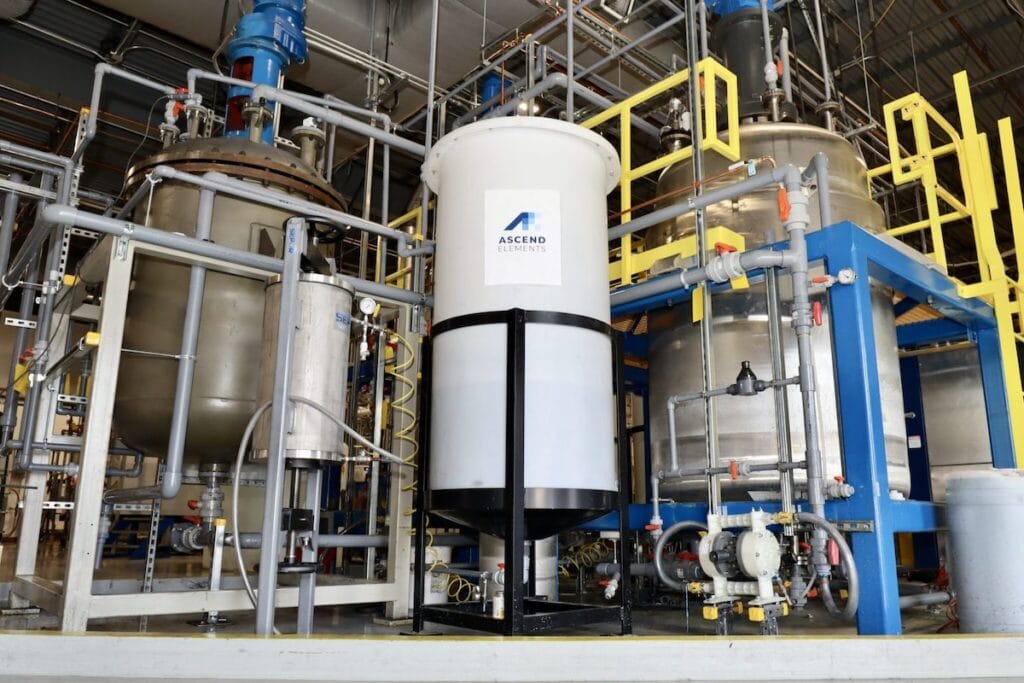
Ascend wanted to keep going. Instead of selling battery confetti, it wanted to turn that material directly into one of the key ingredients inside new batteries. Something called precursor cathode active material, or pCAM.
Most pCAM today gets made in China. Ascend’s pitch was simple: Recycle batteries in the US and turn them directly into new battery ingredients here instead.
That idea landed perfectly during the early EV boom.
In 2022 the company renamed itself Ascend Elements. It wasn’t positioning itself as a recycler anymore. It wanted to become a domestic battery-material supplier at industrial scale.
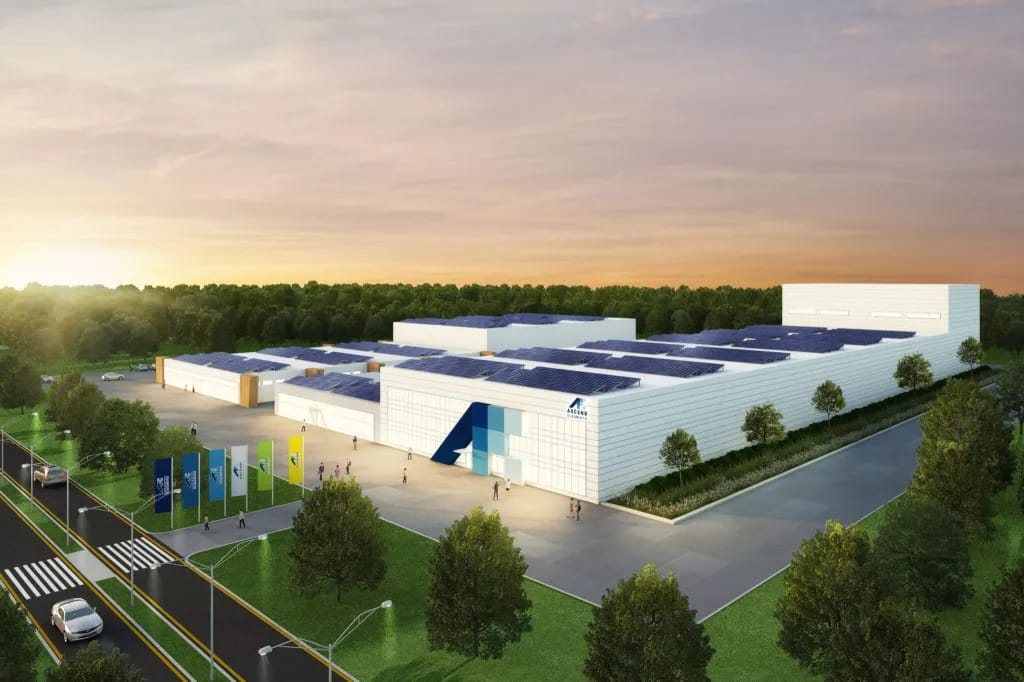
Then came the big bet. Ascend announced plans to build a massive factory called Apex 1 in Hopkinsville, Kentucky. About one million square feet. The goal was to produce enough battery material each year to support roughly 750,000 EVs.
The timing helped. Between 2022 and 2024 the US government was pushing hard to rebuild domestic battery supply chains. Ascend fit perfectly into that plan.
Investors put in nearly $900 million. The Department of Energy awarded roughly $480 million more across expansion programs. The 2023 Series D alone brought in $542 million from major global investors.
From the outside, this still looked like momentum.
Inside the company, the Kentucky flagship was already slipping. Construction disputes surfaced. A major federal grant tied to the project was canceled after a strategy shift mid-build. At the same time the board replaced the CEO with a new one. That usually means the plan isn’t working anymore.
Finally, in April 2026 Ascend filed Chapter 11. CEO Linh Austin described the financial situation as insurmountable. The flagship factory wasn’t finished. The money was gone.
The Numbers:
💰 Nearly $900M+ in investor capital raised
🏗️ $480M in DOE grants awarded across programs
📉 $138M construction dispute tied to Apex 1 contractor claims
🔥 14 safety incidents reported at Georgia site before shutdown pause
🚗 Target output: materials for 750,000 EVs per year
📅 Founded 2015, filed Chapter 11 April 9, 2026
Reasons for Failure:
The company scaled into industrial manufacturing before locking a stable operational base: Ascend tried to do recycling, lithium recovery, pCAM manufacturing, and megaproject construction at once. That is a portfolio strategy inside a single startup. Industrial scale-up punishes that kind of parallel risk stacking fast. Even the Kentucky flagship was reportedly only about 60 percent complete when the crisis peaked, which meant capital was trapped inside a non-productive asset.
Apex 1 became the center of the problem: Everything depended on the Kentucky plant working on schedule. Once contractor disputes reached roughly $138 million and suppliers started filing liens, the project stopped looking stable to investors and partners. Industrial startups rarely recover after their main facility enters litigation territory before production starts.
The subsidy structure shifted mid-build: Ascend’s expansion depended heavily on federal support layered on top of venture capital. The cancellation of a $164 million CAM grant and later reporting around a canceled $316 million Kentucky-linked grant weakened the capital stack right when the plant needed stability. Subsidies accelerate builds but they also create fragility when assumptions change.
Market timing moved against domestic battery-materials economics: EV adoption didn’t stop, but timelines stretched. Automakers delayed plans. At the same time Chinese battery-material suppliers kept pricing pressure high. Industrial startups need a stable ramp window to survive their first large plant. Ascend never got one.
Why It Matters:
Contracts don’t matter if production isn’t running. Supply deals don’t generate cash without a working plant.
Government funding doesn’t guarantee survival. Ascend still ran out of time mid-build.
Trend

GPT Images 2.0
OpenAI released ChatGPT Images 2.0 last week.
And almost overnight, Nano Banana stopped being the reference point. This is the new model people are testing first.
Why it Matters
Text-heavy visuals just became much more usable: If a model can handle dense text, labels, hierarchy, icons, and layout without falling apart, you stop using it just for hero images and start using it for actual communication.
It is better at generating a set, not just a single image: With thinking mode on, it can create up to eight images while keeping style, characters, and objects consistent.
The workflow is shifting from prompting for images to prompting for deliverables
The Model
OpenAI released Images 2.0 inside ChatGPT last week, powered by a new model called gpt-image-2. It’s also already live in the API and Codex, which usually means they expect people to actually build with it, not just play with it.
The main thing they’re pushing is something they call image generation with reasoning. That sounds like marketing language, but there is something real underneath it.
In thinking mode, the model doesn’t just translate your sentence into an image. It expands the prompt, plans the layout more deliberately, and can even use live web context before generating. The result feels less like “prompt → picture” and more like “brief → output.”
You can see this in the examples they chose to show.
They’re not showing fantasy portraits. They’re showing menus, brochures, posters, manga pages, academic explainers, product grids, and editorial layouts. Basically the exact kinds of images older models struggled with the moment you added structure.
Text rendering is the part everyone noticed first.
Multilingual text improved a lot too. Japanese, Korean, Chinese, Hindi, Bengali. These scripts usually broke earlier models much faster than English did. This one holds together noticeably better.
Another change people keep testing is continuity across images.
With thinking mode enabled, the model can generate up to eight related images that stay visually consistent with each other. Same character, same objects, same style. That’s why manga keeps showing up everywhere around this launch. Manga is basically the hardest stress test for layout, typography, and sequential storytelling at the same time.
There are also some practical details that matter more than they sound.
The API supports thousands of output sizes, with aspect ratios up to 3:1 and sizes up to 3840 px on the longest edge. That makes it more usable for banners, portrait posters, mobile creatives, and the random awkward sizes real teams actually need.
It also supports editing with masks and high-fidelity image inputs, so this is not only about generating from scratch. It fits into “take this existing asset and adapt it” workflows too.
Overall, what actually feels new is not that it makes pretty images, but that it can reliably generate assets with structure, text, and continuity well enough to replace a bunch of lightweight design work that previously still needed a human pass.
Help Me Improve Failory
How useful did you find today’s newsletter?Your feedback helps me make future issues more relevant and valuable. |
That's all for today’s edition.
Cheers,
Nico